Our M.F.A. program offers rigorous, professional training in cinema production in conjunction with an understanding of cinema history, theory and aesthetics. The faculty supports production practice in diverse forms — narrative, experimental, documentary, animation or hybrid, and our graduate writers/directors become skilled in both traditional cinematic and emerging digital technologies.
The M.F.A. program also prepares filmmakers to teach cinema at the college or university level. The School of Cinema’s creatively active faculty regularly share from their own production experiences, coordinate master classes with distinguished practicing professionals, arrange for visiting independent filmmakers to screen contemporary work and facilitate student connection with local cinema and arts organizations.
The M.F.A. in Cinema is intended for individuals who wish to pursue independent film and media production. A 60-unit terminal degree, the program offers students the opportunity to focus on any/all of the following areas: documentary, experimental and/or fiction.
Learning Objectives
The M.F.A. in Cinema’s learning objectives strives to enable students to:
- Produce individual creative cinematic works utilizing techniques that span a range of modes, styles and genres.
- Master pre-production, production and post-production skills necessary for cinematic expression.
- Realize a personal creative vision in the cinematic medium.
- Write coherent critical essays using appropriate historical and theoretical materials.
- Gain teaching-related experience.
Applicant Requirements
Applicants must have a GPA of 3.0 in the last two years of undergraduate study. Applicants with degrees in areas other than film who show exceptional potential will be considered for admission to the program.
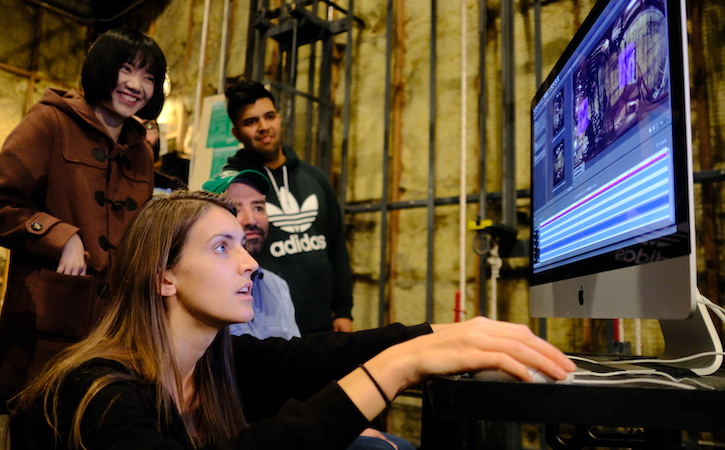
Applicants must meet all general university requirements for admission. The School of Cinema requires candidates to have completed one introductory course in film production and a basic course in non-linear digital editing, or equivalent experience. Students will be expected to use Adobe's Premiere Pro for initial course work.
Prior to admission, all candidates must have at least one sample of creative image moving work in which they had a major creative role (ie: Director, DP/Cinematographer, Writer, Editor, etc.) Additionally, all applicants must submit a resume/CV, a personal statement, an example of academic writing, two letters of recommendation, and unofficial transcripts.
The GRE is NOT required to apply.
Please visit our FAQ page for more information about the M.F.A. program and the application process.
Additional Resources
Requirements for students who entered the program DURING the 2025 – 2026 school year and anytime AFTER the 2025 – 2026 school year.
For students who entered the program before the 2025-2026 school year, please check the “M.F.A. Requirements prior to 2025-2026 school year” tab.
During the first Fall semester of the first year, students will build a foundation in cinema theory, narrative filmmaking, producing, and cinematography. These courses are designed to prepare students for the multi-faceted aspects of production as well as apply theory to their practice.
During the Spring semester of the first year, students will continue studying cinema theory and producing, and will build foundations in documentary filmmaking. Students will also have the chance to take a production elective and will be required to take Directed Teaching Experience in Film Education, a course that prepares students for teaching at a college level.
The second year of the program will include Advanced Directing, Advanced Editing, Experimental Cinema, and will require several theory and production electives. The third and final year of the program will focus on every aspect of the students thesis project from pre-production, production, and post-production.
First Year Required Courses
Fall
|
Course |
Title | Units |
|
700 |
Cinema Theory I | 3 |
|
701 |
Fiction Writing & Producing | 3 |
|
702 |
Fiction Directing | 3 |
|
703 |
Cinematography & Lighting | 3 |
Spring
|
Course |
Title | Units |
|
704 |
Documentary Writing & Producing | 3 |
|
705 |
Documentary Directing | 3 |
|
706 |
Cinema Theory II | 3 |
|
852 |
Directed Teaching Experience in Film Education | 3 |
|
7XX |
Production Elective | 3 |
Second Year Required Courses
Fall
|
Course |
Title | Units |
|
707 |
Advanced Directing | 3 |
|
7XX |
Production Elective (2) | 6 |
|
7XX |
Required Theory Elective (Grad only) | 3 |
Spring
|
Course |
Title | Units |
|
708 |
Advanced Editing | 3 |
|
709 |
Experimental Cinema | 3 |
|
7XX |
Production Elective | 3 |
|
7XX |
Production or Theory Elective | 3 |
Third Year Required Courses
Fall
| Course | Title | Units |
|
770 |
Thesis Development (6 units) |
6 |
Spring
| Course | Title | Units |
|
894 |
Thesis Film Project | 3 |
For more info about these courses, please contact the MFA Coordinator.
Additional Requirements
In addition to required courses noted above, each student must meet departmental requirements for periodic reviews, as follows:
- Formal script review at the end of the first semester.
- Formal progress review at the end of the first year.
- Formal presentation and faculty evaluation of the creative work project proposal at the end of the second year (upon which advancement to candidacy is contingent).
- Documented public screening of the student’s creative thesis project.
Some recent thesis films include:
- A Brighter Summer Day for the Lady Avengers (2024) experimental narrative short, directed by Birdy Wei-Ting Hung (51st Student Academy Awards, Alternative/Experimental Category - Winner)
- Adam, (2020), dramatic short, directed by Pietro Pino (Venice International Critics Week)
- Drip Like Coffee, (2019) dramatic short directed by Anaiis Cisco (Princess Grace Award)
- Shoe Shiner, (2017), dramatic short, directed Andrés Gallegos (Nomination, ASC Cinematography Award)
Requirements for students who entered the program BEFORE the 2025 – 2026 school year.
For students who entered the program during the Fall of 2025 and after, please check the “M.F.A. Requirements 2025 – 2026 school year and after” tab.
All M.F.A. students must complete 42 units of required classes and 18 units of electives over three distinct years.
During the first year, students build a foundation through the study of technical crafts, aesthetics, theory and creative conceptualization — enabling them to express themselves in the language of images and sounds.
In the second year, students take advanced courses that lead to the production of creative work demonstrating original thinking, conceptual clarity, technical skill and the refinement of a personal aesthetic.
In the third year, students complete a creative project that is a culmination of previous work and a reflection of the development of the student’s creative voice.
| Course | Title | Units |
|---|---|---|
| Fall | ||
| CINE 701 | Creative Process I | 3 |
| CINE 710 | Production Practice I | 3 |
| CINE 711 | Production Practice II | 3 |
| CINE 7XX | Cinema Theory Elective (*See details below) | 3 |
| Spring | ||
| CINE 712 | Production Practice III | 3 |
| CINE 852 | Directed Teaching Experience in Film Education (may also be taken in the second year) | 3 |
| CINE 7XX | Cinema Theory Elective (*See details below) | 3 |
| Course | Title | Units |
|---|---|---|
| Fall | ||
| CINE 702 | Creative Process II | 3 |
| CINE 7XX | Cinema Theory Elective (*See details below) | |
| Spring | ||
| CINE 770 | Seminar in Film Production Research | 3 |
| CINE 726 | Cinema Theory II | 3 |
| (students must complete two of the following production courses in the second year) |
| Course | Title | Units |
|---|---|---|
| CINE 761 | Writing and Directing for Cinema | 3 |
| CINE 762 | Advanced Cinematography and Lighting | 3 |
| CINE 763 | Projects in Advanced Editing | 3 |
| CINE 755 | Feature Screenwriting | 3 |
| CINE 713 | Animation Workshop | 3 |
| CINE 715 | Cinematography Workshop | 3 |
| CINE 730 | Experimental Cinema Workshop | 3 |
| CINE 740 | Workshop in Documentary Production | 3 |
First- and second-year required courses must be taken in sequence. Advancement to second and third year of the program is contingent on faculty review and approval by the M.F.A. coordinator.
| Course | Title | Units |
|---|---|---|
| CINE 894 | Creative Work Project | 3 |
M.F.A. Theory Requirements
In addition, M.F.A. students must take four critical theory graduate courses, according to the following guidelines:
Not all courses will be offered each semester. Please check the School of Cinema schedule information for the relevant semester for availability.
| Course | Title | Units |
|---|---|---|
| CINE 720 | Critical Paradigms and the Cinematic | 3 |
| CINE 721 | Cinema Documentary | 3 |
| CINE 723 | Cinematic Forms and Aesthetics | 3 |
| CINE 727 | Cinematic Styles | 3 |
| CINE 728 | Cinematic Histories | 3 |
| CINE 741 | Cinema and the City | 3 |
| CINE 743 | Sexuality in the Cinema | 3 |
| CINE 747 | Post-Colonial Cinema | 3 |
| CINE 748 | Cinema and Cultural Studies | 3 |
| CINE 749 | Critical Practices | 3 |
| CINE 820 | Seminar in Critical Theory | 3 |
| CINE 821 | Seminar in Documentary Cinema | 3 |
You can find course descriptions and details about these courses in the University Bulletin.
Additional Requirements
In addition to required courses noted above, each student must meet departmental requirements for periodic reviews, as follows:
- Formal progress review at the end of the first and second years.
- Documented public screening of the student’s creative thesis project.
Not all courses will be offered each semester. Please check the School of Cinema schedule information for the relevant semester for availability.
More information outlining the M.F.A. degree requirements.
Some recent thesis films include:
- Adam, (2020), dramatic short, directed by Pietro Pino (Venice International Critics’Week)
- Objector, (2020), feature documentary, directed by Molly Stuart (Selection, IDFA)
- Drip Like Coffee, (2019) dramatic short directed by Anaiis Cisco (Princess Grace Award)
- Shoe Shiner, (2017), dramatic short, directed Andrés Gallegos (Nomination, ASC Cinematography Award)
Students must also meet all general university requirements for advancement to candidacy, and receive a “B” or better in all required courses for the M.F.A. degree, as well as successfully pass all formal reviews.
- Produce individual creative film works utilizing techniques that span a range of genres.
- Demonstrate mastery of technical skills necessary to expressing themselves cinematically.
- Demonstrate the realization of a personal creative vision in the cinematic form.
- Demonstrate the ability to locate their personal creative practice in the context of history and traditions of cinema.
- Produce coherent critical essays using appropriate source materials.
- Demonstrate skills in teaching undergraduate film courses.
The School of Cinema accepts new M.F.A. students for the Fall term only. The application opens on October 1 and the M.F.A. Application will be due on February 1.
Early submission is appreciated.
To apply to the M.F.A. in Cinema, you must complete the Cal State Apply application for graduate admission and upload your unofficial transcripts and application documents to the Program Materials section of Cal State Apply. You must complete the entire graduate admission by deadline to be considered for admission.
Applicants may only apply to a single graduate program per application term. The application fee is $70. The School of Cinema is unable to offer any application fee waivers, for more information on fee waivers, please contact the division of graduate studies at gradstudies@sfsu.edu.
After reviewing the Application Procedures below, please visit Cal State Apply to apply for the M.F.A. in Cinema.
Application Instructions
Your application for graduate study to SF State consists of a two-part review:
Part 1
The Division of Graduate Studies reviews your application for general university admission requirements and requires you to upload copies of transcripts from every college or university attended, including study abroad coursework, community college coursework even if transfer credit appears on your degree transcript. Upload clear, legible copies of all transcripts to the Documents section of the Cal State Apply Application. Photos of documents will not be accepted. Make sure you resolve any financial obligations at previously attended institutions so they will release your transcripts.
Division of Graduate Studies
Administration Building, Room 250
1600 Holloway Avenue
San Francisco, CA 94132
Phone: (415) 338-2234
Email: gradstudies@sfsu.edu
Part 2
Applicants must have a GPA of 3.0 in the last two years of undergraduate study. Applicants with degrees in areas other than film who show exceptional potential will be considered for admission to the program.
The School of Cinema requires candidates to have completed one introductory course in film production and a basic course in non-linear digital editing, or equivalent experience is required. Students will be expected to use Adobe's Premiere Pro for initial course work.
Prior to admission, all candidates must have at least one sample of creative image moving work in which they had a major creative role (ie: Director, DP/Cinematographer, Writer, Editor, etc.) Additionally, all applicants must submit a resume/CV, a personal statement, an example of academic writing, two letters of recommendation, and unofficial transcripts.
The GRE is NOT required to apply.
School of Cinema
San Francisco State University
1600 Holloway Ave.
Fine Arts Building, Room 245
San Francisco, CA 94132
Phone: (415) 338-1629
Email: cinegrad@sfsu.edu
Materials Needed to Apply
Prepare application materials in advance before starting the online Cal State Apply application. Please note that the School of Cinema Application Materials can be submitted on the Cal State Apply Application in the “Program Materials” section of the application. Please be aware that there are four tabs in this section of the application, Home, Documents, Evaluations, and Questions. Your Program Materials for the School of Cinema will be submitted within these tabs of the application.

Required Application Documents Breakdown
- Resume/CV (1 – 2 pages) summarizing the applicant's education, awards or recognition, work experience, travel, languages, and special skills
- Personal statement (3 page maximum) discussing aesthetic influences, creative interests, and professional aspirations as a filmmaker, including comments on: the areas of film on which the applicant would like to concentrate, how theory informs his/her/their work as a filmmaker, and the goals he/she/they intend to pursue upon completion of the M.F.A.
- An example of academic writing (7 – 12 pages, double space, 12 pt. font) which illustrates the applicant's ability to make and support a thesis as well as familiarity with scholarly form and expository style. Papers from the film discipline are most useful, but other academic work is acceptable. No journalistic "review” essays or scripts are accepted
- Creative work sample: an example of creative, moving image in which you had a major creative role is required. The example may be live-action, animation, fiction, documentary, or experimental, and it should reflect your aesthetic taste as well as your intellectual and emotional interests.
- You must submit one video that is no longer than 5 minutes. For work longer than 5 minutes, please create a 5-minute excerpt that you feel best represents the work.
- Trailers, reels, or compilations of more than one work WILL NOT be accepted.
- Additional creative work samples: There will be an opportunity on your application to include an additional work sample. This sample may be moving image work, or a sample of another creative work.
- Examples of other creative works include photographs, paintings, screenplays or creative writing. Please note that other creative work samples would not be a substitute for the moving image work. Please email the School of Cinema office with any questions at cinegrad@sfsu.edu.
- Two letters of recommendation from individuals who can attest to the applicant's creativity and aptitude as well as to the quality of past work and potential of future achievements. One letter from a former professor is recommended. The School of Cinema does not provide official recommendation forms. Your recommender will receive an email with a link to upload a reference letter once the School of Cinema Application letter has been completed.
- Unofficial transcripts: Upload two unofficial transcripts to the Cal State Apply application. In addition to any documents required by your program, you are also required to upload legible unofficial copies of transcripts from each college or university attended. Including study abroad coursework, or community college coursework, even if this coursework appears as transfer credit appears on your degree transcript. Full academic disclosure is required. Photographs or screenshots of transcripts will be rejected. An incomplete academic history will significantly delay review of your application. The Division of Graduate Studies may request official transcripts from you at any point during the application review process.
If selected for admission, you will be required to submit official transcripts to the Division of Graduate Studies in order to secure your offer of admission.
CAL State Apply Tips
Create your account AND complete your profile.
TIP: Students who will study on a F1/J1 visa must select Non-Resident for U.S. Citizenship Status under your Extended Profile.
Please note: You will only see a list of programs that aligns with your academic degree objective.
We are pleased to announce that School of Cinema is now part the Western Regional Graduate Program (WRGP) which enables students in 16 Western states and territories to enroll in participating public graduate programs as nonresidents, yet pay the lower resident tuition rate.
Here are some student films produced within the M.F.A. program.
I Lost My Racecar
2022 First Year Film — Dir. Josh Park
Forgotten Fountains
2022 Thesis — Dir. Ellie Vanderlip. Uploaded on Google Drive.

Crows Feet
2021 First Year Film — Dir. Cole Montminy. Uploaded on Vimeo.

For additional student film samples, please email cinegrad@sfsu.edu